|
Sabre Art Studio© GLOUCESTER | |||||||
|
works by DAVID A. HUGHES |
works by JACKIE JOHN |
sabre MUSIC VIDEO -from SabreArt |
Contact |
||||
| Welcome to Sabre Art online. 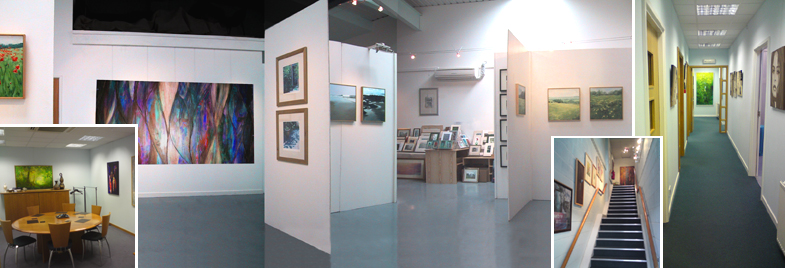 | |||||||
| |
|||||||
|
art studio in Gloucester, Gloucestershire, UK. - Artists producing drawings and paintings, video and music.
DH: " We work in most media and although we do concept pieces and installations, we are not afraid to produce work that we describe as domestic. We need to produce such work because we need the income, but we would do it anyway because it's still as much of a challenge as it ever was, especially portrait commission work. As well as installation work, we have life drawing - figurative work mostly from the college liferoom (the only place you can't fake it ) in pencil,ink, charcoal,oil pastel, soft pastel and water colour; and paintings in, oil,acrylic, watercolour and mixed media; landscape both naturalistic, realistic, and of course the abstract in a variety of themes and media. We've used rusted metal, gravel and dirt,salt sand and sawdust,all manner of things from skips and dustbins, hair, teeth, skin ,and blood but only because I was not more careful with a scalpel. What do you want ? We can do it. ∗What do you mean by 'accessible art'?
JJ: We do not believe that art should always be easy to understand or appreciate, art does have to challenge the eye and brain sometimes. Art does have to challenge society's norms, but we don't think it has to do so all the time. In a world that is challenging enough, there must also be a place for art that comforts, for art that can be an opening toward a deeper understanding and appreciation of aesthetic values. We challenge the notion that art has to be beyond the intellectual and spiritual grasp of most people in order to justify itself. That's what we mean by accessible art. We make no excuses for making art that people are happy to live with and see no contradiction in producing work that reflects all aspects of being and the needs of human beings. Art is art. Whether dealing with themes of destruction or creation, there is ultimately only good art or bad art. Ideas in themselves, are never wrong - it is what one does with those ideas that matter.
DH: Art's not very good at making war on war, it's got a better record at healing or as preventative medicine. Guernica preached to the converted and made the nazi's laugh, even if you could quote ten more, that's a bad record from 20,000 canonised artists. Papillon closed down devils island. Lets leave it to the writers and film. Static visual art in the home and workplace can help as preventative medicine I believe, but I have not seen all the proof I need yet. ∗You don't think it can be used as weapon ?
DH: For ridicule yes, look at Fluck and Law and the shoulders they stood upon. But if you take the war on war analogy further, then nurses and cooks are as essential in the long term to the logistics of war as the soldiers with the guns. Sometimes they get overrun and pick up the gun , but it's not their primary task. Wow, I'm logical. ∗Does your creative practice primarily centre around 2-D work, whether for the home or not?
DH: We have ceramic work but prefer to show ceramics by people that are better at it than we are. As far as 3d work is concerned we move into it occasionally. ∗How large a role does drawing play for you?
DH: I have a portfolio of figure drawings from the life room, but in exhibition I've never shown more than two or 3 at a time, even in exhibitions in Gloucestershire galleries. There aren't many that pick up on the fact that they are actual life drawings, probably because most drawings seen these days are done from photographs. ∗do you think drawing is a lost skill? DH: For us, the vast majority of artists, a result is not possible without drawing in paint. "High Art" is fun, but it is mostly operationally useless to those trying to hold to a strategy for making a steady income outide of a system fuelled by large Museum Galleries, or Multi Millionaire gamblers - and there aren't anywhere near enough of either to patronise a fraction of the tens of thousands of art graduates since the YBA's. Most students are drilled to be cannon fodder for a system that doesn't care that 99 out of a 100 will either have to retrain themselves to do what they should have been taught in the first place, or have to retrain for something else, or spend the rest of their lives in the job centre. A naive impressionable art education system, focuses on a low quantity of high cost artists serving a low quantity of rich collectors. Common sense says it should focus on a high quantity of low cost artists serving the high quantity of ordinary disposable incomes out there, because that means more jobs for artists. In short, art by the many for the many, instead of art from the few for the few. People that say high art is not art do not help. It IS art. It's just that so much of it is not only so very, very dull, it is irrelevant to what most people want to buy, irrelevant to what most artists want and need to make - you cannot carry on being an artist without sales unless you have a private income. ∗Do you consider your own work to be High Art ? DH: High, middle, and low. We wouldn't be the first artists to produce non controversial images where the process itself was the art.]
For us, process is vital as an end in itself, and is a paradigm, a paradigm shift in fact from our former lives. For myself, a large aspect of my work is about process, and that process involves chance and it’s reflection of life. I switch back and forth over the years from waste materials (rusty panels, old doors), to creating their equivalent as blind grounds usually in paint on canvas or board in an attempt to emulate nature in the studio. After that has gone far enough, only then does the controlled part of the work begin; sometimes I’ll work in 3d; sometimes I just use the traditional. More often than not, the most unlikely grounds yield the best results. If I’m really lucky, I get a worthwhile narrative as well. I recycle what doesn’t work and try again. Occasionally if I need to, I regain control with a heavier balance of the traditional. If you centre that paradigm on regaining a measure of control over any circumstance of chance, or in my case - faith, then any direction I go in is bound, for me, to have unity in meaning, method and purpose as well as making it far easier to achieve unity, balance and strength of line in form and content. The fact is, get the process right and you can carry on making art everyday, get it wrong and it's down to the job centre.
In a similar way Jackie's method has always used 'chance' and we recognised it in one another's work when we met.
JJ: I work in a variety of ways, so if I must wear a label let it read, 'Reactive painter'. I react to the diverse possibilities contained within a single idea, or to the opportunities presented by the random application of paint upon a surface. The images that emerge are the starting point for the finished painting. Usually paintings begin as abstracts from which I 'pull' a figurative form, but sometimes the reverse is true. It depends on my reaction to the ideas and images that form in my mind, or on the painted surface as I work. This paradigm that remains the same (focused), allows for something new everyday ( diversity),and diversity means the sales we need to survive and perpetuate the 'art of being an artist' at this level. I dont know if it could work in the top level gallery system because there is pressure to have an (easily) recognisable signature. That may be forgivable for those established who do not want to lose their position or 'branding',but all the way down here a not uncommon criticism equates diversity with lack of focus. But how often have you seen artists doing the same basic work over and over for years, either blind to, or pushed into, what we call tunnel vision but passing it off as focus ? We've worked hard refining our professional practice in order to escape from that. On the one hand we have a 'system' that when it functions at its best we know will stand as high art, or at its least, at least post modern, but occasionally I'll paint a seascape from a photo, and I don't see anything wrong with that. After all, we are not art snobs; when a gallery visitor said he would buy two of our paintings if only the colours matched their decor, we offered to either paint copies in the required colours, or take on the interior design of the room. Although had he accepted the offer, we would probably have changed our minds! We find it almost impossible to copy our own work because of the random way we lay the initial grounds and because I'm not starving, I have the freedom to work the way I want to. Every now and then, an artist will accuse us of being 'commercial artists' because we have a pretty good track record for selling art. It's nonsense. We never produce work in a cynical way, churning out 'crowd-pleasers'; it's just that we don't buy into the notion that "real" art has nothing to do with beauty. A great deal of valid philosophy arose from the contemplation of visual art but wethink it's strange that so many artists now seem to create work purely to illustrate those philosophies. It's all about concept for them and often very little to do with technique or genuine realisation of an idea made flesh. If it is the idea alone that interests you, then why be a visual artist in the first place? The ideas often come as a result of the artwork itself, not the other way round in any event". |
|||||||
|
| |||||||
|
| |||||||
| JACKIE JOHN paintings prints drawings landscape abstract photographs sculptures installations 3d, art exhibitions at Gloucester Cheltenham and Stroud;VAL MILLER paintings prints installations landscape abstract, art exhibitions at Gloucester Cheltenham ;ROLAND BURRA paintings prints drawings, art exhibitions at Gloucester, Cheltenham, Cornwall and London ;GALLERY-3 paintings prints etchings, from art exhibitions at Gloucester Cheltenham and Stroud;TRUDI OCHILTREE paintings drawings prints teacher, art exhibitions at Gloucester, Cheltenham, Stroud and Cardif;DAVID HUGHES paintings prints drawings, art exhibitions at Gloucester and Stroud;
| |||||||